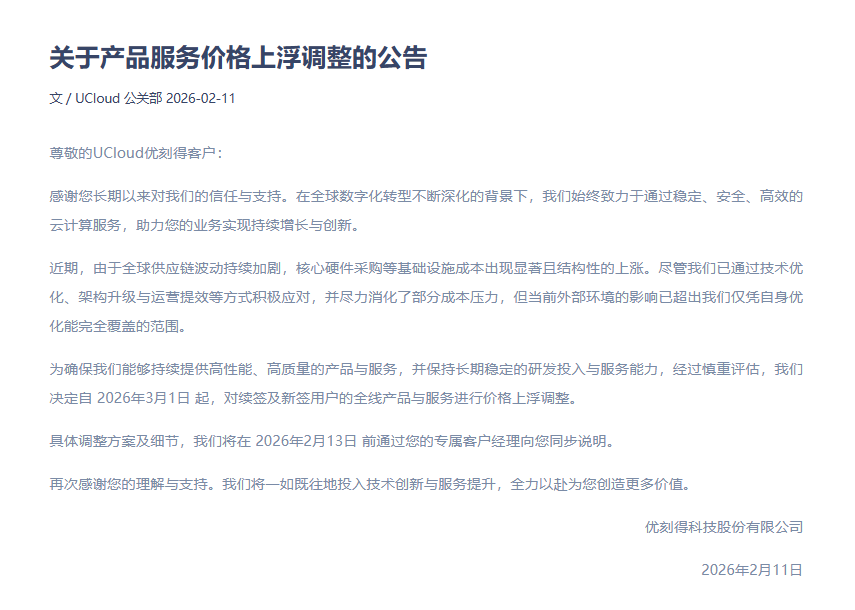
On February 11, 2026, UCloud officially announced that due to ongoing global supply chain volatility and rising procurement costs for core hardware components, the company will implement price increases across its entire product and service portfolio for both new and renewed contracts starting March 1, 2026.
Official announcement: https://www.ucloud.cn/site/about/news/recent/20260211/6914.html
This development is not merely a pricing adjustment by a single cloud provider — it also reflects broader structural cost changes currently affecting the global cloud computing industry.
1. Industry Background Behind the Price Increase
In recent years, global digital transformation has continued to accelerate. AI, large-scale model training, cross-border business operations, and real-time data processing have all driven significant growth in demand for computing power and cloud infrastructure. At the same time, however, the industry is facing several major challenges.
1️⃣ Rising Costs of Core Hardware
- High-performance CPU and GPU prices remain elevated
- Storage chip prices have seen periodic rebounds
- Costs for high-speed networking equipment and switching infrastructure continue to increase
In particular, the explosive growth of AI computing demand has led to structural increases in the procurement costs of GPUs and high-end server hardware.
2️⃣ Global Supply Chain Volatility
- International logistics costs remain unstable
- Manufacturing and export policy changes in certain regions
- Rising costs for data center construction materials and energy
Together, these factors have significantly increased infrastructure deployment costs for cloud service providers.
2. Why Adjust Prices Now?
According to UCloud’s announcement, the company has already attempted to mitigate cost pressures through:
- Technical optimization
- Architecture upgrades
- Operational efficiency improvements
However, when rising costs become both structural and long-term in nature, passing those increases downstream becomes almost unavoidable.
The cloud computing industry typically exhibits the following characteristics:
- Strong economies of scale, where early growth can dilute costs
- Relatively limited profit margins, especially within the IaaS sector
- Heavy dependence on hardware, with servers and networking equipment representing major cost components
Once hardware cost increases exceed what providers can internally absorb, pricing adjustments often become the final option.
3. Impact on Enterprise Customers
The latest price increase will affect:
- New customers
- Renewing customers
Customers currently under fixed-term agreements are generally not expected to see immediate changes, but they may face higher costs during future renewals.
For enterprises, the impact will mainly include:
✔ Increased IT Budget Pressure
Especially for businesses heavily utilizing cloud servers, GPU instances, bare metal servers, and high-bandwidth services.
✔ Re-evaluation of Cost Structures
Companies may need to reassess:
- Resource utilization efficiency
- Elastic scaling strategies
- Multi-cloud deployment approaches
4. Industry Trend: Will Price Increases Become the New Normal?
Globally, several cloud providers have already introduced adjustments in recent years involving:
- Storage pricing changes
- Bandwidth pricing structure optimization
- Higher GPU instance pricing
Future trends may include:
- Stabilization of basic compute pricing
- Persistently high pricing for high-performance computing resources
- More sophisticated pricing models, including on-demand, reserved, and hybrid billing
As a result, UCloud’s latest adjustment is more likely part of a broader industry transformation rather than an isolated event.
5. Recommendations for Enterprises
For businesses currently using or considering cloud services, several strategies may help mitigate future cost pressures.
1️⃣ Lock in Long-Term Contracts
Signing medium- to long-term agreements before the new pricing takes effect may help secure current pricing levels.
2️⃣ Improve Resource Utilization Efficiency
Businesses can reduce waste through:
- Automated scaling
- Resource monitoring and idle resource reclamation
- Cost visibility and analytics
3️⃣ Evaluate Multi-Cloud Strategies
Introducing a multi-cloud architecture can improve flexibility and strengthen negotiating leverage.
Conclusion
UCloud’s decision to raise prices reflects strategic adjustments driven by global supply chain instability and rising hardware costs. From an industry perspective, the move is representative of broader structural changes taking place across the cloud computing sector.
As demand for AI computing power continues to surge and infrastructure costs are reshaped, the cloud industry may be entering a new phase characterized by stable growth alongside steadily rising operational expenses.
For enterprises, the key challenge is not a single round of price increases, but rather how to build a more resilient cloud cost management strategy capable of adapting to future structural shifts.