In today’s overseas server and proxy market, “residential IPs” have become an increasingly important topic. However, many so-called residential IPs on the market are actually mixed sources or even data center IPs disguised as residential ones. This article provides a third-party analysis of VIRCS, covering its business model, infrastructure, IP types, and plan structure to help you determine whether it fits your use case.
1. Company Background & Business Model
VIRCS is not a traditional IDC or VPS hosting provider. Instead, it is a service provider built on real residential infrastructure in the United States.
Its core characteristics include:
- Deployment of broadband lines inside privately owned residential apartments in California
- Licensed access to AT&T and Frontier Communications as an authorized agent
- Packaging real residential broadband into a commercial residential IP service
👉 In other words:
VIRCS resources do not come from data centers—they come from real residential environments.
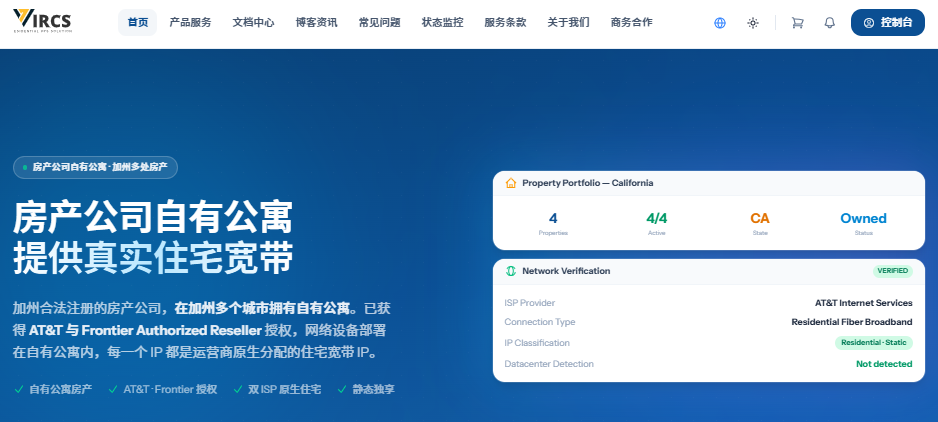
VIRCS Official Website:
https://www.vircs.com/
2. Infrastructure Architecture (Core Advantages)
1. Real Residential Deployment (Not Data Center IPs)
All VIRCS nodes are deployed in privately owned apartments in California, with each apartment serving as a “node” (APT-1 to APT-4):
- Each broadband line connects to an independent ONT modem
- Each line operates independently
- IP addresses are assigned directly by the ISP to residential addresses
- These are native ISP Residential IPs (Residential ISP)
👉 This means:
These IPs are identical to those used by ordinary residential internet users in the United States.
2. Node Scale (Official Disclosure)
Currently VIRCS operates four residential nodes:
| Node | Broadband Scale | Features |
|---|---|---|
| APT-1 | 100+ AT&T lines | Large-scale deployment |
| APT-2 | 80+ AT&T lines | Rack-style deployment |
| APT-3 | 70+ AT&T lines | Wall-mounted deployment |
| APT-4 | 80+ AT&T lines | Modular expansion |
📌 Each node provides:
- One modem per broadband line
- Independent IP assignment
- No interference between lines
3. Operations & Power Infrastructure
VIRCS brings near–data center-grade operations into residential environments:
- APC server-grade PDU (remote per-port power control)
- UPS backup power systems
- 24/7 automated monitoring and alerting
- Real-time line status monitoring
- Failures require on-site manual repair (~3-hour response time)
👉 This is one of the key differences compared to traditional data centers.
3. IP Type Explanation (Important)
VIRCS provides:
👉 Native ISP Residential IPs (Residential ISP)
Key characteristics:
- Assigned directly by ISPs (not proxy pools)
- WHOIS (ARIN) shows “Private Customer”
- Not associated with data centers or hosting providers
📌 Official notes:
- IP ownership can be verified via ARIN (American Registry for Internet Numbers)
- There is no such thing as an “AT&T data center IP” in this context
- All IPs originate from residential broadband lines
4. Coverage Areas
VIRCS currently covers multiple cities in California:
- Irvine
- San Jose
- San Francisco
- Fremont
👉 Coverage spans both Southern California and the Bay Area.
5. Pricing Plans Overview
Plan Comparison
| Plan | Price | Specifications | Use Case |
|---|---|---|---|
| High-Speed Proxy | $34.98/month Link | Static residential IP, up to 50Mbps, unlimited traffic, SOCKS5 + VLESS | Basic proxy usage |
| Dedicated Tunnel | $59.98/month Link | Static IP, 300Mbps, GIA relay, encrypted tunnel | Cross-border access |
| Standard Plan | $35.99/month Link | 4 cores, 8GB RAM, 50GB NVMe, residential IP | Entry-level server |
| Flagship Plan | $55.99/month Link | 8 cores, 16GB RAM, 100GB NVMe | Multi-instance / business use |
| Professional Plan | $99.99/month Link | 12 cores, 24GB RAM, 200GB NVMe | High-performance workloads |
📌 Common features:
- Static dedicated residential IP
- Auto provisioning
- Supports Windows / Linux
- Unlimited traffic (some plans)
6. Use Cases & Limitations
✅ Suitable Use Cases
- Access requiring real U.S. residential IPs
- Cross-border networking environments
- Services requiring ISP-level residential IP authenticity
Important clarification:
VIRCS provides real U.S. residential IPs. It is essentially a local broadband exit and does not offer cross-border acceleration or routing optimization. It only guarantees native U.S. residential connectivity quality.
👉 Therefore:
- From mainland China, latency and stability depend on international routing quality
- No CN2 / GIA optimized return routes are provided
Recommended for mainland users:
- Use with high-quality relay nodes
- For example: BandwagonHost, DMIT with CN2 GIA routing
2026 BandwagonHost Best Node Ranking (CN2 GIA-E DC6 Recommendation)
DMIT Premium CN2 GIA / CMIN2 VPS Recommendations
❌ Restrictions (Official Policy)
- Website hosting / web services
- Proxy pool / “airport” operations
- Resale or sharing
- Attacks, scanning, spam emails
- Cryptocurrency mining
- High-risk financial operations
👉 Violations result in immediate termination without refund.
7. Stability & Compensation Policy
- Failures require on-site repair
- Average response time: ~3 hours
| Downtime | Compensation |
|---|---|
| ≤ 3 hours | No compensation |
| > 3 hours < 1 day | 1 day credit |
| ≥ 1 day | Double compensation |
8. IP Replacement & Refund Policy
Replacement Rules
- 1 free replacement within 24 hours (availability issues only)
- Paid replacement otherwise
- Provider may enforce forced replacement in special cases
Refund Policy
❗ No refunds (digital goods)
- Unhappy IP reputation results
- Third-party risk scoring issues
- Unsatisfactory speed tests
- Improper usage
9. Overall Evaluation
Advantages
- True residential IPs (not data center IPs)
- Privately owned apartment infrastructure
- Multiple California node coverage
- Relatively strong operational system
Disadvantages
- Failure handling depends on manual intervention
- Not suitable for hosting services
- No refund support
- Strict usage limitations
10. Conclusion: Is It Worth It?
VIRCS has a very clear positioning:
👉 It is not a VPS hosting provider, but a “residential IP infrastructure provider.”
If your needs include:
- Authentic U.S. residential IPs
- High-quality clean ISP exit
- Non–data center environment
👉 Then VIRCS is a relatively “niche but powerful” solution.
However, if you need:
- High-availability servers
- Hosting services
- Stable data center environments
👉 Traditional cloud providers are a better fit.