For users who need to run websites, applications, game servers, cross-border businesses, or network relay services over the long term, a dedicated server in Tokyo is well worth considering.
This article covers three Japanese dedicated servers with CN2-optimized connectivity, offered by HNCloud, Henghost, and YXVM. All three are physical servers hosted in Tokyo, rather than ordinary VPS or cloud server instances. Prices start at RMB 799 or $59 per month, with bandwidth options ranging from 20Mbps to 10Gbps to accommodate different workloads.
The main differences between these three products lie in pricing, hardware specifications, bandwidth resources, and network performance across China’s three major carriers:
-
HNCloud: Limited-time pricing at RMB 799/month, particularly good latency for China Mobile users, and multiple bandwidth options.
-
Henghost: 63ms latency on China Telecom and 85ms on China Unicom. A good option for Telecom and Unicom users, but China Mobile traffic takes a less direct route.
-
YXVM: Starting at $59/month, with 1Gbps bandwidth and unlimited traffic included. Offers relatively balanced latency across all three carriers.
Let’s take a closer look at the plans, network test results, and recommended use cases for these three Japanese CN2 dedicated servers.
1. HNCloud: Limited-Time Offer at RMB 799/Month, Bandwidth up to 1000Mbps
HNCloud is operated by Hong Kong United Communications International Limited. Its product lineup includes cloud servers and dedicated servers, with various network solutions for users in overseas markets, including customers in mainland China.
The product featured here is a physical dedicated server hosted in HNCloud’s Tokyo data center. It offers bandwidth options from 30Mbps to 1000Mbps, supports up to 10 IP addresses, and uses direct connectivity from all three major Chinese carriers with optimized routes to mainland China. It is suitable for users who need dedicated hardware resources, reliable network performance, and consistent server performance.
The entry-level HNCloud Japan server features an Intel Xeon E5-2650 processor with 8 cores and 16 threads, 16GB RAM, 500GB SSD storage, 30Mbps bandwidth, and 3 IP addresses. The limited-time promotional price is just RMB 799/month, reduced from the regular price of RMB 1,800/month.
There are also three higher-tier configurations priced at RMB 1,988, RMB 2,988, and RMB 12,980 per month, with bandwidth increased to 50Mbps, 100Mbps, and 300Mbps, respectively. The highest-tier plan uses dual Intel Xeon E5-2650 processors.
Promotion page: HNCloud Double 11 Promotion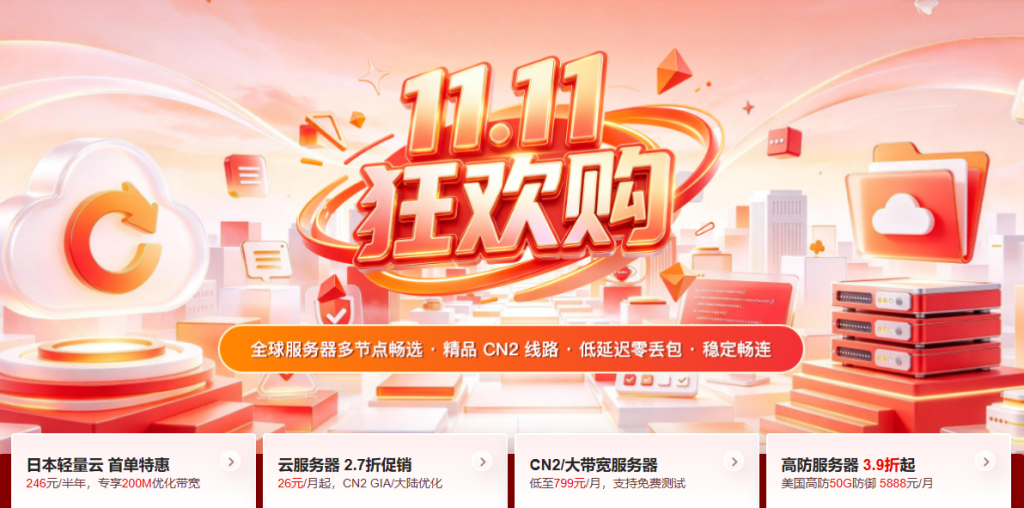
All plans support both Linux and Windows operating systems. Accepted payment methods include Alipay and PayPal.
HNCloud Japan dedicated server plans:
| Specifications | Plan 1 | Plan 2 | Plan 3 | Plan 4 |
|---|---|---|---|---|
| CPU | E5-2650 | E5-2650 | E5-2650 | 2 × E5-2650 |
| CPU Cores | 8 cores / 16 threads | 8 cores / 16 threads | 8 cores / 16 threads | 16 cores / 32 threads |
| Memory | 16GB | 16GB | 32GB | 32GB |
| Storage | 500GB SSD | 500GB SSD | 500GB SSD | 500GB SSD |
| Bandwidth | 30Mbps | 50Mbps | 100Mbps | 300Mbps |
| IP Addresses | 3 | 3 | 3 | 3 |
| Monthly Price | RMB 799 (Limited-Time Offer) | RMB 1,988 | RMB 2,988 | RMB 12,980 |
| Purchase | Order Now | Order Now | Order Now | Order Now |
Network Performance Tests:
Based on the actual test results, this HNCloud Japan server delivers relatively balanced network performance.
-
Average local Ping latency: 98ms, with no packet loss.
-
Average latency across China’s three major carriers: 77ms.
-
China Telecom average latency: 87ms.
-
China Unicom average latency: 82ms.
-
China Mobile average latency: 65ms.
Among the three major carriers, China Mobile delivered the best results, with an average latency of just 65ms. Tests across 100 domestic and international nodes showed virtually no packet loss on overseas nodes.
Regarding routing, all three carriers connect directly from mainland China to Tokyo. China Telecom uses a CN2-optimized route, China Unicom uses AS4837, and China Mobile uses its CMI backbone network. For return traffic, all three carriers connect directly from Tokyo back to mainland China, with no obvious detours.
In other performance tests, disk I/O reached 358MB/s, and the test server was able to fully utilize its 30Mbps bandwidth in both upload and download directions.
Advantages:
-
Limited-time pricing of RMB 799/month makes it an affordable physical dedicated server option.
-
Average latency across China’s three major carriers is 77ms, with China Mobile averaging 65ms.
-
Bandwidth options range from 30Mbps to 1000Mbps.
-
CN2-optimized routing for China Telecom, with direct routes for all three carriers in both directions.
-
Supports up to 10 IP addresses.
Disadvantages:
-
The RMB 799/month price is a limited-time offer, compared with the regular price of RMB 1,800/month.
-
The entry-level plan only includes 30Mbps bandwidth.
-
The 300Mbps plan costs RMB 12,980/month, making upgrades considerably more expensive.
Recommended for: Users on a limited budget who want a physical server in Japan, especially those who prioritize China Mobile connectivity, multiple IP addresses, and dedicated hardware resources.
2. Henghost: 63ms on China Telecom and 85ms on China Unicom
Henghost was established in 2010 and is operated by SonderCloud Limited (HK). Its services include cloud servers, dedicated servers, domain registration, and web hosting. Its data centers cover Hong Kong, Japan, South Korea, Singapore, the United States, and other locations. The company primarily provides overseas hosting services for customers in mainland China.

Henghost official website: https://www.henghost.com/
The product featured here is a Japanese physical dedicated server hosted in Henghost’s Tokyo data center. The entry-level plan costs RMB 1,200/month and comes with an Intel Xeon E3-1230v3 processor, 16GB RAM, 240GB SSD storage, 20Mbps bandwidth, and 3 IP addresses.
For connectivity, the product provides a CN2-optimized route for China Telecom and AS4837 connectivity for China Unicom. It is therefore better suited to workloads primarily serving Telecom and Unicom users.
Henghost offers four Japan dedicated server plans, starting at RMB 1,200/month and going up to RMB 1,500/month. The entry-level configuration uses an E3-1230v3 processor, while the other three plans use E5-2650 processors. The main differences between the plans are memory and storage capacity.
All plans include 20Mbps bandwidth and 3 IP addresses. Payments via Alipay and PayPal are supported. The official website also runs promotions from time to time, so it is worth checking the current pricing before placing an order.
Henghost Japan dedicated server plans:
| Specifications | Plan 1 | Plan 2 | Plan 3 | Plan 4 |
|---|---|---|---|---|
| CPU | E3-1230v3 | E5-2650 | E5-2650 | E5-2650 |
| Memory | 16GB | 8GB | 16GB | 32GB |
| Storage | 240GB SSD | 240GB SSD / 1TB HDD | 240GB SSD / 1TB HDD | 240GB SSD |
| Bandwidth | 20Mbps | 20Mbps | 20Mbps | 20Mbps |
| IP Addresses | 3 | 3 | 3 | 3 |
| Monthly Price | RMB 1,200 | RMB 1,200 | RMB 1,300 | RMB 1,500 |
| Purchase | Order Now | Order Now | Order Now | Order Now |
Network Performance Tests:
Henghost’s Japan server has some interesting network characteristics. Its local latency is very low, but performance varies considerably among China’s three major carriers.
-
Average local Ping latency: 63ms, with virtually no packet loss.
-
Average latency across China’s three major carriers: 133ms.
-
China Telecom average latency: 63ms.
-
China Unicom average latency: 85ms.
-
China Mobile average latency: 259ms.
The results show that latency is quite good for China Telecom and China Unicom users, while China Mobile users experience significantly higher latency.
Tests across 100 domestic and international nodes showed virtually no packet loss. The routing details are as follows:
-
China Telecom: Direct connection from Shanghai to Tokyo via the 59.43 CN2 route.
-
China Unicom: From Shanghai via Osaka to Tokyo over AS4837.
-
China Mobile: Traffic leaves Shanghai, detours through Hong Kong and Germany, and then reaches Tokyo.
The detour through Europe on China Mobile’s route is the main reason its average latency reaches 259ms.
As a result, this server is not an ideal choice for users on every carrier. If your business primarily serves China Telecom and China Unicom users, its network performance is worth considering. However, if a significant portion of your users are on China Mobile, you should be more cautious.
Advantages:
-
Average latency of 63ms on China Telecom and 85ms on China Unicom.
-
China Telecom uses a CN2-optimized route.
-
Virtually no packet loss in tests across 100 domestic and international nodes.
-
Plans start at RMB 1,200/month and include 3 IP addresses.
-
Established in 2010, with Alipay and PayPal supported.
Disadvantages:
-
China Mobile latency averages 259ms, with traffic taking a detour through Hong Kong and Germany.
-
All plans are limited to 20Mbps bandwidth.
-
The entry-level plan only includes 240GB SSD storage, which may be insufficient for some workloads.
Recommended for: Websites, applications, and business projects primarily serving China Telecom and China Unicom users. It is not the first choice for workloads with a high proportion of China Mobile users.
3. YXVM: 1Gbps Bandwidth and Unlimited Traffic, Starting at $59/Month
YXVM primarily offers dedicated servers and VPS products, with data centers in Hong Kong, Japan, Singapore, and other locations. The product featured here is a dedicated server in its Tokyo data center, focusing on high bandwidth and generous traffic resources. The entry-level plan costs $59/month and includes 1Gbps bandwidth with unlimited traffic.
Official website: https://yxvm.com/
Compared with the previous two products, YXVM’s main advantages are its bandwidth and traffic allocation. It is worth considering for users who need to deploy network relay services, run high-traffic applications, or handle workloads with demanding network throughput requirements.
The entry-level YXVM Japan dedicated server uses an Intel Xeon E3-1230 v6 processor with 4 cores running at 3.5GHz. It comes with 16GB RAM, 250GB storage, 1Gbps bandwidth, unlimited traffic, and 5 IP addresses for $59/month.
The higher-tier plan uses dual Intel Xeon Gold 6138 processors, with 128GB RAM, 1TB storage, 10Gbps bandwidth, and 100TB traffic. It costs $149.99/month.
The two plans have clearly defined target users. The entry-level plan focuses on 1Gbps bandwidth and unlimited traffic, while the higher-tier option provides more powerful hardware and a 10Gbps network port.
YXVM Japan dedicated server plans:
| Specifications | Plan 1 | Plan 2 |
|---|---|---|
| CPU | Intel Xeon E3-1230 v6 | 2 × Intel Xeon Gold 6138 |
| CPU Cores | 4 cores, 3.5GHz | Dual processors |
| Memory | 16GB | 128GB (2 × 64GB) |
| Storage | 250GB | 1TB |
| Bandwidth | 1Gbps | 10Gbps |
| Monthly Traffic | Unlimited | 100TB |
| IP Addresses | 5 | Not specified |
| Monthly Price | $59 | $149.99 |
| Purchase | Order Now | Order Now |
Network Performance Tests:
YXVM’s Japan server delivers relatively balanced latency across all three major Chinese carriers. It also has the lowest average latency across the three carriers among the three products covered in this article.
-
Average local Ping latency: 84ms, with no packet loss.
-
Average latency across China’s three major carriers: 67ms.
-
China Telecom average latency: 68ms.
-
China Unicom average latency: 62ms.
-
China Mobile average latency: 72ms.
-
Latency to Hong Kong, Macau, Taiwan, and Southeast Asia: as low as 41ms.
The average latency across all three carriers is just 67ms. The difference between China Telecom, China Unicom, and China Mobile is less than 10ms, indicating relatively balanced performance.
In tests across nearly 100 global nodes, each node underwent 100 Ping tests. There was virtually no packet loss in either domestic or international locations.
Regarding routing, all three carriers connect directly from Shanghai to Tokyo:
-
China Telecom: CN2-optimized route.
-
China Unicom: AS4837 route.
-
China Mobile: CMI backbone network.
Combined with 1Gbps bandwidth and unlimited traffic, this server is a good fit for network relay services, high-volume data transfers, and other applications that require substantial bandwidth.
Advantages:
-
The entry-level plan includes 1Gbps bandwidth and unlimited traffic.
-
Average latency across China’s three major carriers is 67ms, with balanced performance across all three.
-
Latency of 68ms on China Telecom, 62ms on China Unicom, and 72ms on China Mobile.
-
Includes 5 IP addresses by default.
-
Plans start at $59/month, with a higher-tier 10Gbps option also available.
-
Latency to Hong Kong, Macau, Taiwan, and Southeast Asia can be as low as 41ms.
Disadvantages:
-
The provider is relatively small in overall scale.
-
Only two configurations are available.
-
The entry-level plan has 250GB of storage.
Recommended for: Users who need substantial bandwidth and traffic resources, such as network relay operators, high-traffic applications, and projects that need balanced connectivity across China Telecom, China Unicom, and China Mobile.
4. Comparing the Three Japan CN2 Servers and Choosing the Right One
We’ve now covered the Japanese dedicated servers from HNCloud, Henghost, and YXVM. Although all three are hosted in Tokyo and offer optimized network routes for users in mainland China, they differ considerably in price, hardware specifications, bandwidth, and latency across the three major carriers.
The following tables summarize their main specifications and test results to make it easier to choose the right server for your needs.
Core specifications compared:
| Comparison | HNCloud | Henghost | YXVM |
|---|---|---|---|
| Data Center | Tokyo, Japan | Tokyo, Japan | Tokyo, Japan |
| Server Type | Physical Dedicated Server | Physical Dedicated Server | Physical Dedicated Server |
| Starting Price | RMB 799/month | RMB 1,200/month | $59/month |
| Entry-Level CPU | E5-2650 | E3-1230v3 | E3-1230 v6 |
| Entry-Level Memory | 16GB | 16GB | 16GB |
| Entry-Level Storage | 500GB SSD | 240GB SSD | 250GB |
| Entry-Level Bandwidth | 30Mbps | 20Mbps | 1Gbps |
| Entry-Level Traffic | Not specified | Not specified | Unlimited |
| Default IP Addresses | 3 | 3 | 5 |
| China Telecom Latency | 87ms | 63ms | 68ms |
| China Unicom Latency | 82ms | 85ms | 62ms |
| China Mobile Latency | 65ms | 259ms | 72ms |
| Average Latency Across Three Carriers | 77ms | 133ms | 67ms |
| Optimized Routes | CN2 / AS4837 / CMI | CN2 / AS4837; China Mobile takes a detour | CN2 / AS4837 / CMI |
| Maximum Bandwidth | Up to 1000Mbps | 20Mbps | 10Gbps |
Recommendations based on different requirements:
| User Requirements | Recommended Provider | Reason |
|---|---|---|
| Limited budget, but need a physical server | HNCloud | Limited-time offer at RMB 799/month |
| Need high bandwidth and unlimited traffic | YXVM | 1Gbps bandwidth and unlimited traffic |
| Primarily serving China Telecom users | Henghost | Average China Telecom latency of 63ms |
| Primarily serving China Unicom users | YXVM | Average China Unicom latency of 62ms |
| Primarily serving China Mobile users | HNCloud | Average China Mobile latency of 65ms |
| Best overall performance across all three carriers | YXVM | Average latency of 67ms across all three carriers |
| Need multiple IP addresses | HNCloud / YXVM | Up to 10 IPs / 5 IPs by default |
| Prefer an established hosting provider | Henghost | Established in 2010 |
Final Recommendations:
If price is your main consideration, HNCloud’s limited-time offer at RMB 799/month is quite attractive. It includes 16GB RAM, 500GB SSD storage, 30Mbps bandwidth, and 3 IP addresses. For users on a limited budget who still need a physical server in Japan, it is worth considering. However, keep in mind that RMB 799/month is a limited-quantity promotional price, so check availability before ordering.
If bandwidth and traffic are your priorities, YXVM is the more compelling option. For $59/month, you get 1Gbps bandwidth, unlimited traffic, and 5 IP addresses. Its average latency across China’s three major carriers is 67ms, with relatively little difference between China Telecom, China Unicom, and China Mobile. This makes it particularly attractive for network relay services and high-volume data transfers.
Henghost is another option if your business primarily serves China Telecom and China Unicom users. Its latency results of 63ms on China Telecom and 85ms on China Unicom are quite good. However, China Mobile latency reaches 259ms due to a routing detour through Hong Kong and Germany. If a significant proportion of your users are on China Mobile, HNCloud or YXVM would be better choices.
Overall, each of these three Japan dedicated servers has a different focus: HNCloud offers an affordable entry point for physical servers, Henghost is better suited to China Telecom and China Unicom users, while YXVM stands out with 1Gbps bandwidth, unlimited traffic, and balanced network performance across all three major carriers.
5. Frequently Asked Questions About Japan CN2 Servers
1. What Is a Normal Latency for a Japan Server?
Tokyo is relatively close to mainland China. With optimized network routes, latency from mainland China can typically range from a few dozen milliseconds to around 100ms. Actual results depend on the carrier, network routing, and test location.
The test results for the three servers covered in this article are:
-
HNCloud: Average latency of 77ms across China’s three major carriers.
-
Henghost: Average latency of 133ms across all three carriers. China Mobile’s 259ms latency pushes up the overall average, while China Telecom and China Unicom average 63ms and 85ms, respectively.
-
YXVM: Average latency of 67ms across all three carriers, with relatively balanced performance.
When choosing a Japan server, don’t rely on a single average latency figure. You should also check the performance of China Telecom, China Unicom, and China Mobile separately.
2. Which Japan Server Is Best for China Mobile Users?
If your services primarily target China Mobile users in mainland China, HNCloud and YXVM are the recommended options.
Their average China Mobile latency results are:
-
HNCloud: 65ms.
-
YXVM: 72ms.
-
Henghost: 259ms.
Henghost’s China Mobile traffic takes a detour through Hong Kong and Germany, resulting in significantly higher latency. It is not recommended for workloads with a large proportion of China Mobile users.
3. Which Japan Server Should I Choose If I Need High Bandwidth?
Among the three products, YXVM offers the most attractive bandwidth configurations.
-
HNCloud: Bandwidth options from 30Mbps to 1000Mbps.
-
Henghost: All plans include 20Mbps bandwidth.
-
YXVM: The entry-level plan includes 1Gbps bandwidth and unlimited traffic. The higher-tier plan offers 10Gbps bandwidth and 100TB traffic.
If you need to run network relay services, high-traffic applications, or other services with demanding throughput requirements, YXVM is the option worth prioritizing.
4. What Should I Check Before Renting a Japanese Dedicated Server?
There are several important things to check before renting a server:
First, confirm whether the promotional price is still available.
HNCloud’s RMB 799/month price is a limited-time offer, compared with its regular price of RMB 1,800/month. Check whether promotional stock is still available before placing your order.
Second, check network performance across all three major carriers.
Routing can vary significantly between carriers. Henghost is a good example: its latency is low for China Telecom and China Unicom, but China Mobile traffic takes a considerable detour.
Third, confirm bandwidth and traffic limits.
YXVM’s entry-level plan includes 1Gbps bandwidth and unlimited traffic, while its higher-tier plan offers 10Gbps bandwidth and 100TB of traffic. For HNCloud and Henghost, you should confirm their specific traffic policies with the providers before purchasing.
Fourth, check the number of IP addresses.
HNCloud’s entry-level plan and Henghost’s plans each include 3 IP addresses, while YXVM’s entry-level plan includes 5. HNCloud supports up to 10 IP addresses, depending on the selected configuration.
Fifth, check the available payment methods.
All three providers support Alipay. HNCloud and Henghost also support PayPal.
5. What Is the Difference Between a Japan CN2 Server and a Regular Japan Server?
The main difference is the network routing.
Regular Japan servers may use international BGP connectivity. When users in mainland China access these servers, traffic passes through the international gateways of different carriers, and actual latency and stability depend on the routes taken.
CN2-optimized connectivity is primarily designed to improve network performance for China Telecom users. It can provide a better connection experience in certain network environments. However, having a CN2 route does not mean that all carriers use the same network path. China Unicom and China Mobile users should also consider their respective routing arrangements.
Therefore, when choosing a Japan server, don’t just check whether it offers CN2 connectivity. You should also examine the outbound and return routes for all three major carriers, along with actual Ping test results.
Summary: If you’re looking for a physical server in Tokyo that offers good connectivity for users in mainland China, choose based on your budget, bandwidth requirements, and the proportion of users on each carrier. HNCloud starts at RMB 799/month and is suitable for users on a limited budget. Henghost is a better fit for China Telecom and China Unicom users, while YXVM is ideal for users who need 1Gbps bandwidth, unlimited traffic, and balanced network performance across all three major Chinese carriers.