For users looking to deploy overseas businesses, cross-border e-commerce websites, international online stores, or personal websites, Singapore has long been one of the most popular server locations. Tencent Cloud’s Singapore Lightweight Application Server not only provides native IP resources but also offers network routes optimized for mainland China while maintaining highly competitive pricing.
In this review, we will take an in-depth look at Tencent Cloud Singapore Lightweight Server, including IP characteristics, network latency, routing performance, stability, and pricing plans to help users better understand its real-world performance.
Tencent Cloud Singapore Lightweight Server Features
Tencent Cloud Singapore Lightweight Application Server offers the following key features:
| Item | Details |
|---|---|
| Data Center Location | Singapore |
| IP Type | Native Clean IP |
| Bandwidth | 20Mbps – 30Mbps |
| Network Route | CN2 Optimized Network |
| Operating Systems | Linux, Windows |
| Application Images | WordPress, OpenClaw, BaoTa Panel, and more |
| Entry-Level Configuration | 2 vCPU, 2GB RAM |
| Starting Price | ¥30/month |
| Payment Methods | WeChat Pay, QQ Wallet, UnionPay |
Advantages
- Native clean IP addresses
- Optimized access from mainland China
- Direct connectivity for China Telecom, China Unicom, and China Mobile
- Windows operating system support
- Affordable pricing for entry-level users
- One-click deployment of popular applications
Disadvantages
- Relatively higher latency on China Unicom networks
- Monthly traffic limits apply
Tencent Cloud Singapore VPS Network Test
The following sections analyze Tencent Cloud Singapore servers from multiple perspectives.
IP Characteristics Test
First, we examined the IP information of the server.
The results show:
- Native IP address
- Good IP reputation and cleanliness
- Suitable for overseas business deployment
- Strong international internet connectivity
For users who require a genuine overseas IP environment, native IPs generally offer advantages over standard data center IPs.
Local Ping Latency Test
Testing from a local China Mobile broadband connection produced the following results:
| Test Item | Result |
|---|---|
| Average Latency | 107ms |
| Packet Loss | 0% |
The results indicate:
- Minimal network fluctuations
- Stable connectivity
- No noticeable packet loss
This performance is sufficient for website access, remote management, and lightweight business deployments.
Nationwide Three-Carrier Ping Test
Additional testing was conducted across China’s three major telecom operators.
| Network | Average Latency |
|---|---|
| China Telecom | 114ms |
| China Unicom | 220ms |
| China Mobile | Approximately 120ms |
| Hong Kong, Macau, Taiwan | 39ms |
| National Average | 121ms |
The results show:
- Excellent performance on China Telecom
- Stable connectivity on China Mobile
- Significantly higher latency on China Unicom
- Outstanding access speeds from Hong Kong, Macau, and Taiwan
Overall, the Singapore location is better suited for China Telecom and China Mobile users.
Global Network Stability Test
Continuous monitoring was conducted across multiple global regions.
International Nodes
- Virtually no packet loss
- Excellent network stability
Mainland China Nodes
- Good China Unicom stability
- Good China Mobile stability
- Occasional minor fluctuations on China Telecom
Overall, Tencent Cloud’s Singapore data center demonstrates strong international network stability.
Tencent Cloud Singapore Server Route Analysis
Besides latency, network routing also plays a critical role in access quality.
The following tests analyze outbound routes for China’s three major carriers.
China Telecom Route
Network path:
Domestic Node → Guangzhou Gateway → Singapore Data Center
Route characteristics:
- Passes through 59.43 backbone nodes
- Uses CN2 optimized routing
- Relatively direct route
China Telecom users can expect excellent performance.
China Unicom Route
Network path:
Domestic Node → Guangzhou Gateway → Hong Kong Node → Singapore Data Center
Route characteristics:
- Uses AS4837 routing
- Transit through Hong Kong
This contributes to the relatively higher latency experienced by China Unicom users.
China Mobile Route
Network path:
Domestic Node → Shanghai Gateway → Hong Kong Node → Singapore Data Center
Route characteristics:
- Uses the CMI international backbone network
- Generally stable routing performance
China Mobile users can expect a good overall experience.
Tencent Cloud Singapore Lightweight Server Pricing
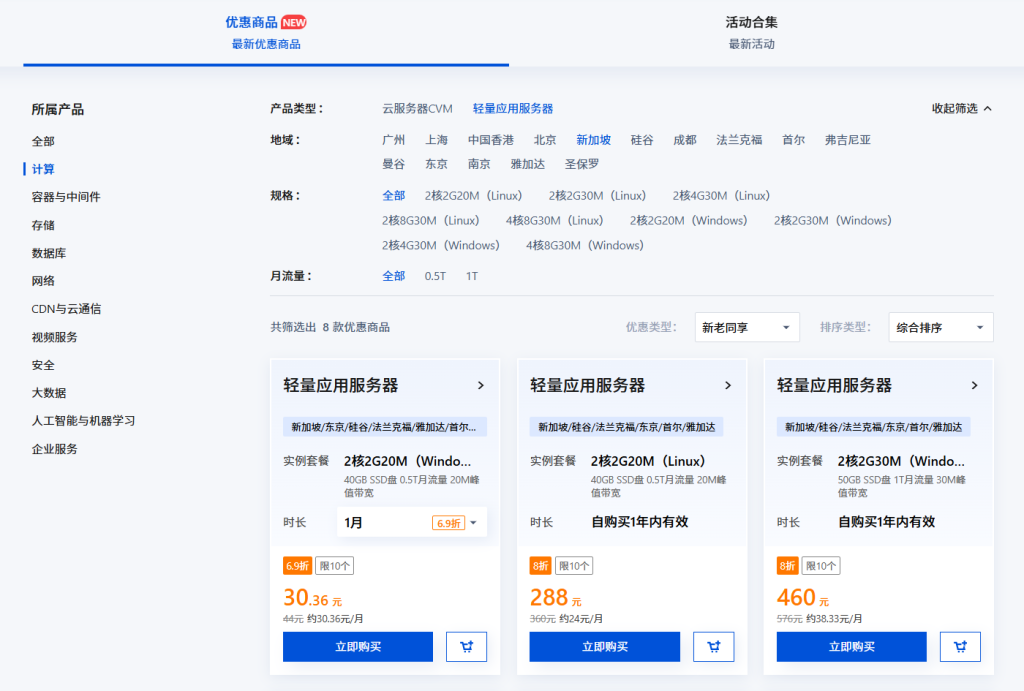
Tencent Cloud currently offers multiple Singapore Lightweight Server configurations.
| RAM | CPU | SSD Storage | Bandwidth | Monthly Traffic | Price |
|---|---|---|---|---|---|
| 2GB | 2 vCPU | 40GB | 20Mbps | 500GB | ¥30/month Link |
| 2GB | 2 vCPU | 50GB | 30Mbps | 500GB | ¥33/month Link |
| 4GB | 2 vCPU | 60GB | 30Mbps | 500GB | ¥42/month Link |
| 4GB | 2 vCPU | 70GB | 30Mbps | 500GB | ¥54/month Link |
From the available configurations:
- Entry-level plans start with 2 vCPU and 2GB RAM
- Bandwidth begins at 20Mbps
- Sufficient storage capacity
- Suitable for personal websites and small-to-medium businesses
How to Purchase a Tencent Cloud Singapore Server
If you plan to purchase a Tencent Cloud Singapore Lightweight Application Server, follow these steps:
Step 1: Access the Tencent Cloud Console
Log in to the Tencent Cloud website.
Step 2: Select Lightweight Application Server
Find “Lightweight Application Server” in the product catalog.
Step 3: Choose the Singapore Region
Select:
Singapore
Step 4: Select Your Configuration
Choose according to your requirements:
- CPU specifications
- Memory size
- Storage capacity
- Subscription period
Step 5: Complete Payment
Tencent Cloud supports:
- WeChat Pay
- QQ Wallet
- UnionPay
Once payment is completed, the server will be provisioned automatically.
Frequently Asked Questions (FAQ)
Does Tencent Cloud Singapore provide native IP addresses?
Yes.
Testing confirms that Tencent Cloud Singapore Lightweight Servers provide native IP addresses with good reputation and cleanliness.
Is the Singapore server suitable for website hosting?
Yes.
Singapore is geographically close to mainland China and offers relatively low latency, making it suitable for:
- WordPress websites
- Corporate websites
- Independent e-commerce stores
- Cross-border e-commerce platforms
Does Tencent Cloud Singapore support Windows?
Yes.
Users can install:
- Windows Server
- Ubuntu
- Debian
- CentOS
- AlmaLinux
and other operating system images.
How are the network routes for Tencent Cloud Singapore?
China Telecom uses CN2 optimized routing.
China Unicom uses AS4837 routes.
China Mobile uses the CMI international backbone network.
Overall, China Telecom and China Mobile users experience the best performance.
Is Tencent Cloud Singapore suitable for cross-border e-commerce?
Yes.
Its native IP resources can meet the requirements of many overseas business scenarios, while the Singapore location provides excellent connectivity throughout Southeast Asia.
Conclusion
Based on comprehensive testing, Tencent Cloud Singapore Lightweight Application Server offers strong competitiveness in both network quality and pricing. Its native clean IP resources, CN2 optimized routing, and affordable entry-level pricing make it a popular choice for personal websites, cross-border business deployments, and overseas application testing.
From a network perspective, China Telecom and China Mobile users can enjoy excellent performance, while China Unicom experiences slightly higher latency but remains acceptable overall. For users seeking a native IP environment and stable international connectivity on a limited budget, Tencent Cloud Singapore Lightweight Server is a VPS solution worth considering.