In recent years, the cybersecurity landscape has undergone significant changes. DDoS attacks are no longer an issue exclusive to large platforms; they have gradually become “common” and “automated.” Whether it’s a small download site, an independent website, an e-commerce platform, an API, or even a personal project, it can face sudden traffic attacks without warning, causing service interruptions.
Many site owners feel that while server costs are decreasing, maintaining stable website operations has become increasingly challenging.

1. Why Are Websites More Vulnerable to Attacks Today?
Current Internet attacks are highly automated and not necessarily “targeted”; they often involve bulk scanning and random attempts.
Common attack types include:
- DDoS traffic attacks (UDP / TCP / SYN Flood)
- CC attacks (simulating real user requests)
- High-frequency API requests
- Web scraping and resource exhaustion tests
- Vulnerability scanning and port probing
- HTTP slow attacks
- Spam traffic and bot visits
These attacks can now be executed with low-cost tools and are even “commoditized” in some gray markets.
High-risk website types usually include:
- Download and resource sites
- Cross-border e-commerce websites
- Gaming platforms
- API service platforms
- Blockchain and Web3 projects
- Overseas business systems
- Advertising and traffic distribution platforms
In many cases, websites are not “hacked” but overwhelmed by traffic.
2. What Is the Core Role of High-Protection CDN?
Many people mistakenly think a CDN is just an “acceleration tool,” but the essence of a high-protection CDN is entirely different.
Regular CDN:
- Caches static resources
- Improves access speed
- Reduces origin server load
High-Protection CDN:
- Traffic scrubbing and attack filtering
- Hides the real server IP
- Identifies abnormal access behavior
- Blocks malicious requests
- Ensures continuous business availability
In short:
The core of high-protection CDN is not “faster,” but “keeping the website alive.”
3. Why Are No-Real-Name High-Protection CDNs Becoming More Popular?
In recent years, “no real-name + quick deployment + support for encrypted payment” high-protection CDNs have grown rapidly. The main reasons are:
(1) Faster Deployment
Traditional CDNs usually require:
- Business verification
- Real-name authentication
- Manual review
- Payment method binding
New overseas high-protection CDNs usually allow:
- Immediate registration and use
- Activation within minutes
- Automatic generation of access configuration
(2) Supports USDT and Other Payment Methods
More platforms now support:
- USDT-TRC20 (mainstream)
- USDT-ERC20
- BTC / ETH
Advantages include:
- Fast settlement
- No cross-border restrictions
- Low transaction fees
- Enhanced privacy
(3) Suitable for Cross-Border and Privacy-Focused Businesses
Some business scenarios require low real-name verification, such as:
- Overseas multi-site projects
- Blockchain applications
- API service platforms
- International advertising systems
- Game acceleration services
These users care more about stability and privacy rather than traditional enterprise verification processes.
(4) Better Adapted to Global Traffic Structures
Compared to traditional CDNs, overseas high-protection CDNs emphasize:
- Global node coverage
- Anycast routing
- International route optimization
- Attack resilience
4. High-Protection CDN Capability Structure (Core Comparison Table)
| Feature Module | Regular CDN | High-Protection CDN |
|---|---|---|
| Core Purpose | Cache acceleration | Attack protection + traffic scrubbing |
| Origin Server Protection | Weak | Strong (IP hiding) |
| DDoS Protection | None or weak | Strong |
| CC Protection | Basic | AI detection + behavior analysis |
| Origin Fetch Mechanism | Simple | Multi-layer filtered origin fetching |
| Node Architecture | CDN nodes | Global scrubbing nodes |
| Applicable Scenarios | Static websites | High-risk business systems |
5. Main Features of High-Protection CDN (Example: CDN07)
Some overseas high-protection CDNs are evolving into “intelligent protection systems.” Typical capabilities include:
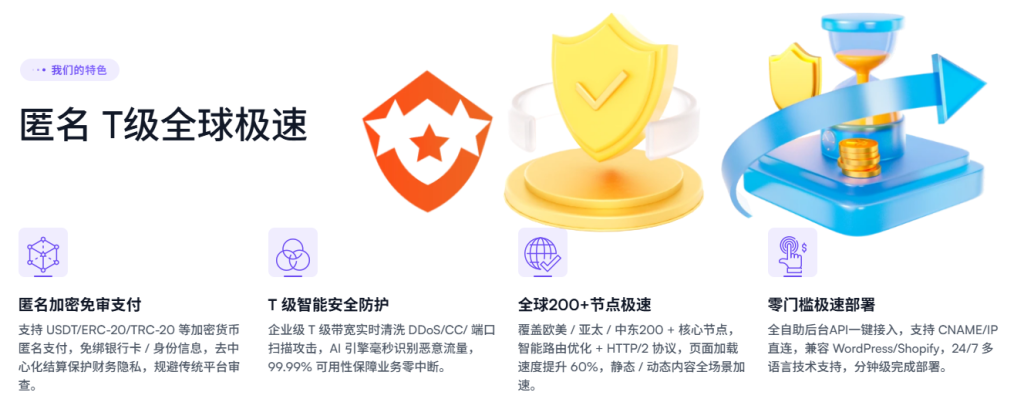
1) Global Node Architecture
Covering multiple regional nodes, such as:
- Asia
- North America
- Europe
Distributed nodes reduce single-point pressure and improve attack resilience.
2) Multi-Layer Traffic Scrubbing Mechanism
Traffic is analyzed across multiple dimensions, such as:
- Request frequency
- Geographical distribution
- Header characteristics
- User-Agent behavior
- TCP connection patterns
Abnormal traffic is filtered automatically based on policies.
3) Origin IP Hiding and Origin Protection
Core capabilities include:
- Hiding origin server IP
- Origin authentication mechanisms
- Preventing direct access
- Node proxy forwarding
Structurally, this reduces the chance of attackers directly connecting to the server.
4) CC Attack Detection and Optimization
For attacks simulating real users, common methods include:
- JS challenge
- Browser verification
- Behavior analysis models
- Dynamic rate limiting
6. Who Is CDN07 Suitable For?
Based on practical application scenarios, it is more suitable for:
- Cross-border e-commerce websites
- API service platforms
- Gaming and acceleration services
- Download and resource sites
- Web3 and blockchain projects
- High-concurrency business systems
- Overseas independent websites
- Cross-border e-commerce websites
- API service platforms
- Gaming and acceleration services
- Download and resource sites
- Web3 and blockchain projects
- High-concurrency business systems
- Overseas independent websites
The core keywords here are: stability, anti-attack capability, and fast deployment.
7. Key Factors When Choosing a High-Protection CDN
Many users tend to focus only on “protection level,” but the real important factors are:
- Node quality (whether they are real edge nodes)
- Scrubbing capability (support for complex attack detection)
- Origin stability (no impact on normal traffic)
- Response speed (support and emergency handling capability)
- HTTPS and HTTP/3 support
8. FAQ (Frequently Asked Questions)
Q1: Is a no-real-name CDN safe?
From a technical perspective, it is a standard CDN service when used legally. Security mainly depends on the provider’s architecture and node capability.
Q2: Can a high-protection CDN completely block attacks?
It cannot guarantee “absolute protection,” but it can significantly reduce the impact of attacks and ensure business continuity.
Q3: Will a CDN slow down my website?
A high-quality high-protection CDN usually does not slow down websites. In many cases, it may even improve speed due to optimized edge nodes.
Q4: What are the advantages of USDT payments?
The main advantages are cross-border convenience, fast settlement, lower fees, and fewer restrictions compared to traditional payment methods.